For the first time in my life, I underwent surgery. Just a few days earlier, I was still parading down the ski slopes, despite a hand that was already injured. I persisted, to the very end, in applying a kind of stoic dogmatism, a mastery of self, while my body barked its nervous torment. Eventually, I had to face the obvious: I could not withstand this ordeal for long through sheer physical force—inevitably diminished.
From that moment on, pain was no longer a mere representation aligned with the natural order of things. No: it expelled me from my "vital norm", took possession of my entire body. After several inconclusive examinations, the diagnosis was delivered: "rupture of the ulnar collateral ligament of the thumb." Surgery was unavoidable. "We have to operate, there's no other choice," said the young surgeon—slender in appearance, his severe voice indistinguishably shaped by either mild smoking or the full occupation of his professional role. Emotional asceticism is an integral part of medical deontology. Medicine operates within a scientific rationality that leaves little, if any, room for affect. And yet, the caregiver lives through an intense emotional experience in the physical proximity of the patient. The patient, reduced to the imbalance of their bodily integrity, becomes a marginal being—almost taboo—because they escape the rational representation of proper anatomical functioning.
The physician thus stands at the intersection of two rationalities. First, the scientific paradigm: illness as a deviation from the normal state, instituting new "norms of life" that reshape everyday existence. Second, a symbolic rationality: the patient as a temporarily hyper-affected individual, their body disrupted, their mind contaminated by the anxiety of a drastically reduced life norm. The suffering individual evokes compassion and the desire to alleviate pain. This second rationality raises a crucial question for medicine: at what point is a patient sufficiently ill to warrant emotional accompaniment?
As I absorbed the news, the surgeon busied himself—almost zealously—trying to introduce a semblance of humanism into what was, after all, a routine and low-risk operation.
"Do you have any questions? I'm here to answer them."
"Yes, doctor. How long will it take? Will I feel anything? How big will the incision be? Will I regain full mobility in my left thumb?"
"It's a fairly straightforward procedure, very seasonal. We even call it 'skier's thumb' in medical jargon. I'll make a small incision on the inside of the thumb, like this," he said, drawing a line with a pen at the base of my thumb. "Then I'll place a small titanium anchor at the end of the damaged ligament so it doesn't shift again. The whole thing will take no more than half an hour. You'll then wear a custom-made splint for five weeks, followed by a few physiotherapy sessions to address stiffness caused by immobilisation… Don't worry. It'll be fine."
In the moment, I could only be worried. Still, I had to internalise medical rationality myself: I was being taken care of, by a hand specialist no less. It would be fine.
I was admitted to hospital two days later at 8 a.m. After struggling to put on sterile clothing, I made one last attempt to resist hospital procedures when I was instructed to wear the hairnet as well. Around me were mostly elderly men and women. I felt a faint sense of injustice—why should I be here, me, young, in the so-called prime of life? Suddenly, my name echoed through the room. That was it. I was approached by a nurse carefully preparing the trolley on which I would henceforth be transported.
"You know, I can walk," I said, in a burst of masculine pride. The nurse, impassive, merely pointed to where I was to lie down. This first stage of the operation was experienced as a bodily humiliation: the patient is immediately reduced to partial invalidity (or total, from the institution's point of view), brutally made conscious of it. The hospitalised, operated or institutionalised patient becomes a mere convenience—just another body to be treated. Anonymisation is partial, of course: our identity is reduced to a name and the reason for our presence.
Surgery establishes a particular relationship to care. While it involves attentiveness to pain, it inevitably institutes a technicising paradigm, aimed at alleviating suffering and, above all, repairing. The environment itself is designed to sterilise our relationship to the world: the social world is all but erased, diminished, rationalised to serve hospital efficiency. The hospital is a biological machine; it strips the patient of the symbolic bacteria clinging to them upon entry. Everything contributes to this. Architecture itself participates in this disorientation: dull or falsely soothing colours, incomprehensible colour codes, oppressive suspended ceilings, endless corridors, interchangeable rooms offering nothing to anchor oneself. No space is truly inhabitable.

The sterile theatre: where bodies become legible as problems to be solved.
This medical enclosure is haunted by other forces: management, time constraints, silent profitability. Care here is not gentle—it is efficient. Every gesture is precise, unquestionable. There is no room for hesitation or affect: emotion would be a parasite, a procedural failure. Medical staff cannot afford to feel; affects are too coloured, too unpredictable. They must divest themselves of emotion, as one removes jewellery before entering the operating theatre. This is not a moral failing—it is a structural necessity. But it comes at a cost: the patient becomes a surface of intervention, a localised problem, an organic whole rendered "problematic".
Before entering the operating theatre, my trolley-bound self paused in an antechamber—the anaesthesia room. Patient anxiety is already accounted for in the protocol: a computer crackles out looping "zen" music sourced from YouTube. I am now stripped of my lived body. Merleau-Ponty shows that the lived body differs from the body-as-object in that it is the site of lived perception—a flesh that is never mere matter but the very condition of our being-in-the-world. Anaesthesia places this lived body in brackets. It no longer suffers, but no longer perceives either, immobilised by (legal) drugs. My bodily consciousness is suspended, along with the possibility of lived experience. At that precise moment, my body ceases to be mine in the phenomenological sense. It becomes a physical body among others, a biological support fully available for technical intervention. The world no longer appears through it; it will now be treated from the outside.
Everything then unfolds very quickly. My inert left arm is placed on a metal table, mechanically scrubbed and disinfected with iodine by assistants. A blue drape is raised between me and my arm, as if it were symbolically amputated from myself. Suddenly, the surgeon enters—an exuberant grand shaman, covered head to toe.
"So, how are you feeling, Mr Ferret? Ready? Not too stressed?"
I dodge the last question—no need to dwell on my anxiety. Of course I'm stressed, doctor, you're about to open my hand, I think.
Though the arm sleeps, I feel it being manipulated with a scalpel, my flesh scraped at its depths; it's war on my left. I glance to the right. The "monitor" beeps at regular intervals, in rhythm with my heartbeat. Desperate for distraction, I decide to play with it. I try to consciously alter my heartbeat to affect my toy. It beeps louder. It's funny. I discover, with naïve enthusiasm, that I can still act upon something—not my body, but its indicator. I no longer inhabit my body, but its signal. Life has shifted: no longer in the drugged flesh, but in the betraying beep. The surgeon, focused, no longer looks at me. He looks elsewhere, inward. I look at the beep. At that moment, we are two parallel attentions, coordinated by the same operation, yet radically dissociated. He works on an organ; I cling to a modest rhythm.

The clinical landscape: monitors, beeps, and the reduction of life to measurable signals.
"All done, young man!" exclaims the surgeon. "I've put on a temporary rigid bandage while we prepare your splint."
I am swiftly ushered out by a nurse. The operation lasted twenty-five minutes in total. The end is near, I think. But first comes the recovery room. And the recovery room is absolutely not designed for a conscious patient. I am placed in the middle of this large room, awkwardly bent over in a wheelchair. Around me, inert bodies slumber slackly. Most lie with mouths open; some drool onto their gowns. Electrodes are attached to their skin as if harvesting their bioelectrical energy. In sudden confusion, I think of The Matrix: drugged warriors cultivated by machines, their minds pacified by simulated reality. This is the hospital matrix. The nurses are the heroes unplugging enslaved bodies. They move between beds, administer substances, consult medical files: "young male patient, early thirties, operated under general anaesthetic for anal fissure"; "female, seventy, operated for herniated disc."
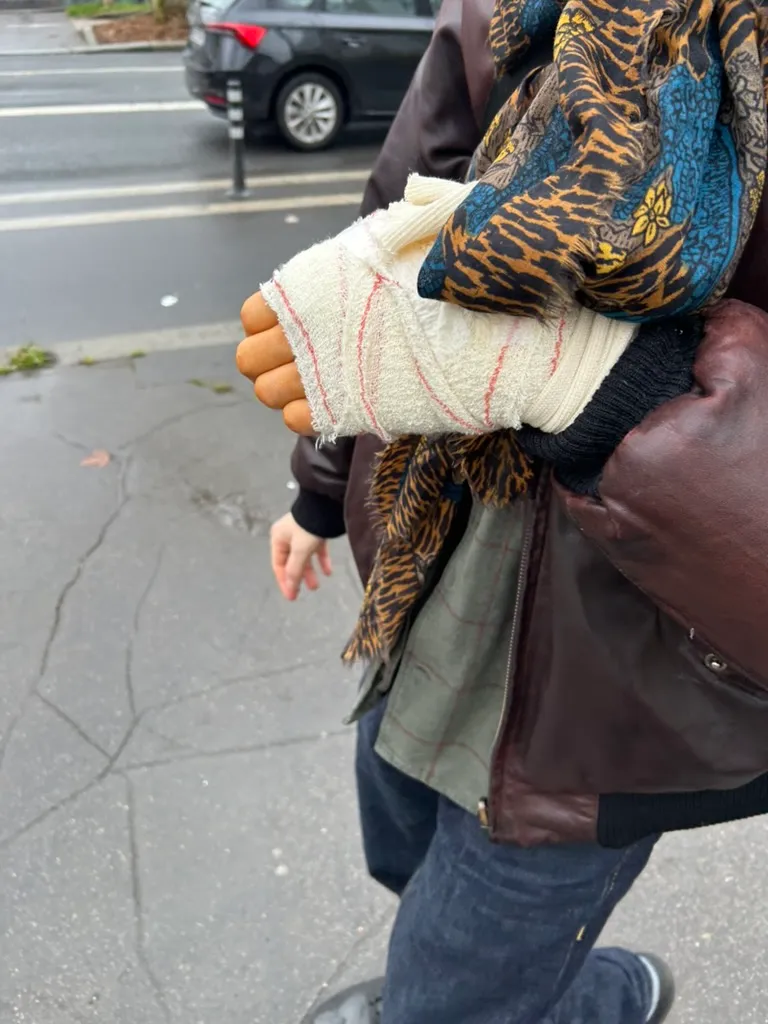
The repaired body: sutured and bandaged, waiting for meaning to be stitched back in.
I laugh softly—not because others' medical files amuse me (perhaps a little), but because I am a protocol anomaly: awake, conscious, aware of what is happening. I can break medical confidentiality. I breach the hospital's fourth wall. The nurses speak in front of me. I relativise my own case; I calm myself. The space depresses me, inevitably. I have nothing to do here—no one should, really. As I start to fidget, another caregiver pulls me out of this tunnel. A snack is offered—a reward for good conduct, soldier. At that moment, I just want to get out. A nurse rattles off some instructions about wound care; I nod without really listening. I think of my burnt espresso at the corner café. Release me.
"Do you have someone to accompany you?" the nurse asks gently.
"Yes." (Maybe. I don't know. It's fine. I can walk.)
I quickly realised upon leaving that the hospital environment is not fully aware of the violence it sustains. Illness, pain, surgery are wounds to identity; they raise the question: who am I now? What is the social self? The patient can become a second-class individual, invisibilised, systematically reduced to their injury. Society always permeates definitions of the injured and the healthy. As Georges Canguilhem shows, illness redefines the contours of the normal and the pathological. Disease is another way of life. Life is normative; it cannot be thought without norms. The pathological is not the absence of norms, but a restriction of normativity—a less flexible norm of life.
Thus, the hospital heals by fragmenting. It isolates pathology from lived experience, lesion from history, pain from the one who feels it. The world must disappear for the body to become legible. So we sterilise, disinfect, simplify. Reality is too complex for care; it must be reduced. This is not spectacular violence, but administrative, polished violence. Necessary—and yet violence nonetheless.
Contemporary research confirms that this is not an isolated perception, but a structural phenomenon. Studies in social sciences describe "dehumanisation in healthcare": processes by which patients are treated as objects or abstractions rather than subjects with dignity, history and meaning—arising from clinical routines, reduced empathy, mechanisation of care and loss of patient agency. Dehumanisation is also experienced by caregivers themselves, often even more violently.
Five years after the peak of the Covid-19 pandemic, Le Monde revisited healthcare workers who had kept crisis diaries in 2020. Their testimonies reveal deep disillusionment: diminished recognition, persistent suffering, an unchanged system despite promised reforms. Many left hospital work; those who remain describe exhaustion and invisibility.
Mathilde Padilla, 26, an intensive care nurse at the American Hospital, recounts being thrown into frontline care during her training in 2020. Assigned to care homes and understaffed hospitals, she faced death, broken families, infected colleagues, and collective exhaustion. "It wasn't about learning to care," she says, "but about holding on."
The hospital does not merely heal; it tests bodies and subjectivities. Humanity is rationed there—like beds, staff, and time.
When I left the hospital, my thumb was repaired. Repaired through injury. Repaired through complete vulnerability. My relationship to my body has now shifted norms—for at least five weeks. The ligaments were reattached, the wound sutured; it was now my responsibility to stitch meaning back into my body—for the time being. My espresso and my fag are waiting.